
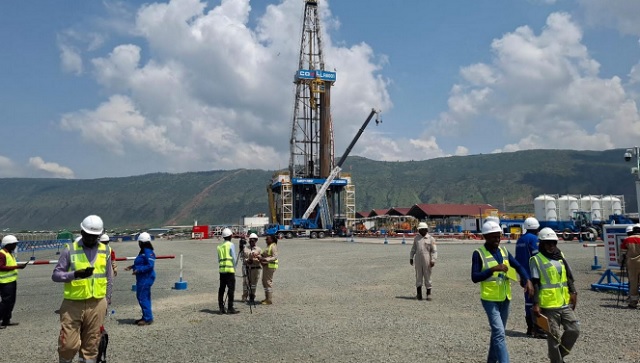
Australia’s DGR Global Limited recently announced that its exploration license for the Kanywataba oil block in Ntoroko district had expired, with the government of Uganda reclaiming the rights over the area.
The company, which has no option of renewing the license after it exhausted the maximum eight-year period that one is allowed to explore for oil under Uganda’s law, said it was looking at different options of how to move ahead with its other oil bloc – the Turaco.
DGR has at least two more years on its Turaco oil license, with the option of renewal for another four years if need be, although there are high chances that the company might exit that project too.
“…the Company has been notified by the Uganda Ministry of Energy and Development that the Petroleum Exploration Licence for Kanywataba, held by Armour Energy Uganda (SMC) Ltd, expired on 27 May 2025,” the company noted in a statement.
It added: “The Company advises that the recent challenging capital market conditions have not been accommodating and that it continues to explore all available options with regards the remaining Turaco exploration licence.”
In April, the future of the Kanywataba and Turaco oil blocks looked uncertain as DGR battled financial hardships. DGR had by then written off the loans it had lent to its subsidiary, Armour Energy from Australia, to develop the Kanywataba, offering a strong indication that it had long dumped the project.
The expiry of the Kanywataba license ended eight difficult years for DGR Global’s experience in western Uganda as the company suspended work twice by triggering the force majeure clause in the agreement it signed with Uganda’s government.
The company first suspended work in 2019 when it said that heavy rains had made the roads in Ntoroko district impassable, and later extended the halt of activities after the emergence of the global Covid-19 pandemic in 2020.
Even before DGR Global resumed work, the company faced a number of barriers. Uganda’s oil project came under attack from environmental activists in 2022, with critics pointing to the threats of displacement of people and the possible dangers of spewed toxic fumes that are responsible for climate change.
Also, DGR created a special-purpose vehicle in early 2023 called Conjugate Energy, which was domiciled in the United Kingdom. Conjugate was assigned the duty to hold the Kanywataba and Turaco interests, and also shield it from the financial troubles that its subsidiary, Armour Energy, was facing in Australia.
Conjugate was scrapped off the United Kingdom company registry in April 2025 over its failure to meet filing requirements. The delisting was seen as a final blow to DGR’s interests at Kanywataba, and threw the future of Turaco into uncertainty.
The Kanywataba block – located 40km away from the bubbly Kingfisher oil block that is operated by China’s Cnooc – was once seen as a positive addition to Uganda’s oil assets. Cnooc first drilled the block in 2012 although the results were not good enough for the company to move ahead with the project.
DGR, through its subsidiary Armour Energy, made promises of turning around the fortunes of Kanywataba when it won a four-year exploration license in September 2017. DGR estimated that there was more than 1.6 billion barrels of oil in place at Kanywataba based on some seismic studies that had been undertaken in the area.
The company promised to drill a couple of wells in its second term of the license. No well was ever drilled. The Uganda government has now repossessed the Kanywataba license, with prospects that the block could be on offer when the country kicks off an oil licensing round.
The government is yet to release the schedule of the licensing round, while the names of the blocks that will be on offer are not known. Uganda needs more oil if the industry’s two signature projects – the oil pipeline and the oil refinery – that are being developed co-currently are to generate the kind of return that the investors are looking for.
So far, Uganda is said to hold between one billion and 1.4 billion barrels of recoverable oil. After construction is completed, the 1,443km East African Crude Oil Pipeline between Hoima district in western Uganda and Tanga district in eastern Tanzania will transport 216,000 barrels of crude oil per day, with a ramp-up of up to 246,000 barrels of crude oil per day.
The commissioning of this pipeline, which is being developed by France’s TotalEnergies, China’s Cnooc and the governments of Uganda and Tanzania, is scheduled for some time in 2027 at the earliest.
The 60,000-barrels-of-oil-per-day refinery, which is being developed by Alpha MBM Investment from the United Arab Emirates, will have the first right of call to Uganda’s crude oil resources after construction is complete.
The oil supply constraints that the two projects will face will be a point of fixation in the industry.
This story first ran on the Deep Earth International website.
