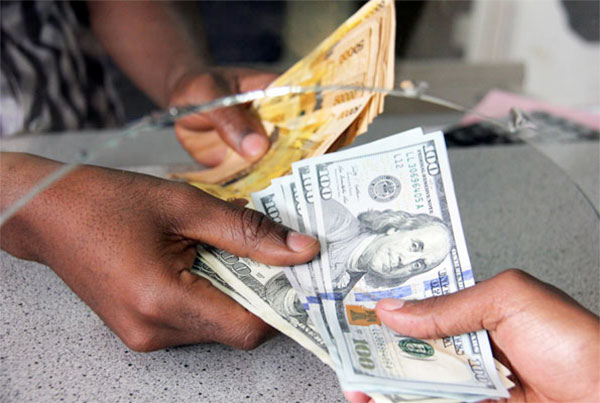
The local unit was relatively weak during the week, with dollar demand from offshore investors, energy and manufacturing firms outstripping existing supply from commodity exporters and remittance firms.
Logistics News
DRC | May | 2024
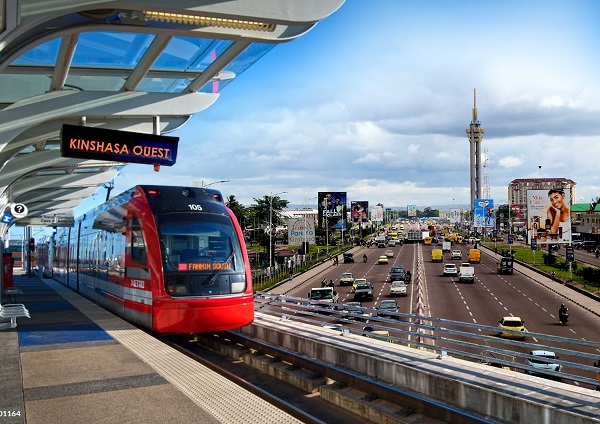
Faced with rapid population growth and inadequate development, DRC is grappling with critical transport infrastructure challenges especially in the capital Kinshasha.
The current transportation system meets less than half of the daily demand, according to the city’s urban transport master plan.
Now, Africa Finance Corporation (AFC), together with Alstom, a pioneer in sustainable mobility, has signed a Memorandum of Understanding to propel the development of the MetroKin rail project in Kinshasa.
This significant partnership was announced alongside the recent state visit of His Excellency Félix Tshisekedi, President of the Democratic Republic of Congo, to France.
The partnership builds on AFC’s prior agreement with Trans Connexion Congo (TCC) to develop a mass transit system that extends over 300km of railroad in Kinshasa, the most populous city in Africa.
The project will unfold in four phases, starting with the overhaul of a 25km stretch from Kinshasa’s central station to N’Djili International Airport, completely upgrading the existing railway.
AFC has committed an initial investment of US$3 million to advance the project development phase, leading to financial closure. As the Mandated Lead Arranger, AFC is spearheading this transformative urban project.
Alstom’s involvement as a strategic industrial partner supports the broader goal of enhancing urban mobility across Africa.
Banking on huge experience
Drawing from its experience in South Africa’s urban train systems and regional projects like Dakar’s express train and Abidjan’s first metro line, Alstom is set to significantly contribute to Kinshasa’s transit overhaul.
The MetroKin rail project aims to expand and modernize the existing rail network, improving connectivity, reducing greenhouse gas emissions, and significantly cutting transportation times between the suburbs and city center.
Amadou Wadda, Senior Director of Project Development & Technical Solutions at AFC, said:
“We are pleased to welcome a global institution of high repute like Alstom to the project. Their expertise will be crucial as we push forward with this project, which promises to reshape Kinshasa’s economic landscape, create numerous jobs, and transform lives.”
Erick Onepunga Yongo, Managing Director of MetroKin said: “Under the lead of AFC, with the support of Alstom and the Congolese government, the materialization of this project becomes effective through the project company MetroKin.SA”.
Bernard Peille, Managing Director at Alstom for Africa stated: “Through our enhanced presence in the region, Alstom is committed to partnering with MetroKin to support the development of an effective mass urban transit solution for Kinshasa.
We aim to contribute to the city’s development ambitions by leveraging our global expertise and supporting its citizens in their mobility needs.
The project has reached significant milestones, with Alstom joining at a crucial time when detailed technical designs are being finalized.
The combined strengths and shared vision of AFC, Metrokin, and Alstom are set to ensure the successful completion of the development phase by the end of 2024.
Africa’s Top 10 countries with the best logistics performance.
From the shiny cars lining up at the dealership to the countless goodies stacked on supermarket shelves, and even the packages delivered right to our doorsteps, logistics is the invisible force that keeps it all moving. With it, we can get our hands on the things we need and want.
Consider logistics as the lifeblood of the global economy, ensuring that goods and resources move efficiently to where they are needed. Despite its crucial role, this sector still faces various challenges that hinder its growth globally.
In Africa, a continent teeming with a bustling population and abundant natural resources, the movement of goods and people, both within and beyond its borders, encounters obstacles due to inconsistent and often insufficient logistics infrastructure.
However, certain African nations stand at the forefront of the logistics sector when compared to their counterparts.
In 2023, the World Bank released a Logistics Performance Index (LPI) to evaluate how different countries worldwide are faring in terms of logistics. This index assesses six key aspects of logistics performance, including trade- and transport-related infrastructure, the quality of logistics services, and the punctuality of shipments, all rated on a scale of 5.
Here are the top 10 countries in Africa with the best logistics performance:
| Rank | Country | Logistics competence and quality score | LPI score. |
| 1 | South Africa | 3.8 | 3.7 |
| 2 | Egypt | 2.9 | 3.1 |
| 3 | Namibia | 2.9 | 2.9 |
| 4 | Rwanda | 3.0 | 2.8 |
| 5 | Djibouti | 2.8 | 2.7 |
| 6 | Congo, Rep. | 2.9 | 2.6 |
| 7 | Guinea-Bissau | 2.6 | 2.6 |
| 8 | Mali | 2.5 | 2.6 |
| 9 | Nigeria | 2.3 | 2.6 |
| 10 | Algeria | 2.2 | 2.5 |
Emirates partners with Mauritius and Uganda, supporting inbound tourism targets to both nations.
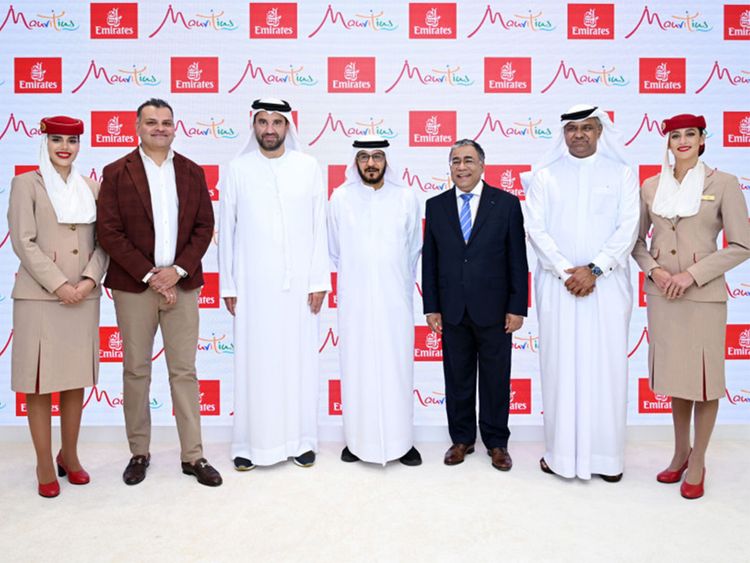
Dubai: Emirates has signed agreements with the Mauritius Tourism Promotion Authority (MTPA) and the Uganda Tourism Board (UTM) on the sidelines of the Arabian Travel Market (ATM).
Emirates pledged its continuous support to the island nation of Mauritius by renewing its partnership with the Mauritius Tourism Promotion Authority.
In an alliance that dates back to 2012, Emirates and MTPA have committed to joint initiatives designed to promote tourism to Mauritius. The airline has been operating there since 2002 and now offers double-daily A380 services.
In 2023, nearly 1.3 million tourist arrivals were recorded for Mauritius, with Emirates playing a vital role in transporting visitors to the island.
Ahmed Khoory, Emirates’ Senior Vice President, Commercial Operations in West Asia & Indian Ocean, said: “Emirates is proud to serve Mauritius since 2002 continuously and to be playing a key role in achieving the country’s tourism targets through our partnership with Mauritius Tourism Promotion Authority. By operating double daily A380 services, we have the capacity to transport up to 1,000 tourists per day into the island, and we hope to continue making a positive impact on the country’s tourism economy.”
Arvind Bundhun, Director, MTPA, said: “We are thrilled about the renewed partnership between Emirates Airline and MTPA. The arrival of Emirates in Mauritius has boosted our tourism sector by opening the Emirati market and allowing us to reach Russia, Eastern Europe, and the Middle East. With Dubai’s hub to nearly 140 destinations, Emirates also provides global connectivity to the island.”
Emirates and the UTM signed a Memorandum of Understanding (MoU) to drive inbound tourism and boost visitors to Uganda, the Pearl of Africa.
Badr Abbas, Emirates Senior Vice President of Commercial Operations for Africa and Lilly Ajarova, said, “Uganda has been a key destination on our global network for over two decades, and one of the most loved in Africa. Through this partnership with the UTM, we are solidifying our commitment to driving international travellers to experience Uganda’s stunning natural landscapes.”
Ms Lilly Ajarova, the UTM CEO, said: “The signing of this MoU is a significant milestone in promoting Uganda, also affectionately known as the Pearl of Africa, as a competitive tourism destination. The UTM is excited to partner with Emirates to benefit from its worldwide network and attract tourists to Uganda.”
Under the MoU, Emirates will identify critical markets to promote Uganda as a favourable tourism destination and encourage travellers to experience its abundant natural, cultural and adventure attractions. The UTM will work closely with the airline to develop programmes for trade partners, hoteliers, and tour operators to market and stimulate the industry.

WFP to set up a Regional Logistics Hub in Uganda – Country Director
KAMPALA
The World Food Programme (WFP) is planning to set up a logistic hub in Uganda for the region.
“We are planning to establish a logistics hub for the entire region here in the country to supply the surrounding countries,” said Abdirahman Meygag, the World Food Programme Country Director.
Meygag revealed this during a meeting with the Prime Minister Robinah Nabbanja at the Office of the Prime Minister in Kampala.
Currently, Uganda is hosting over 1.6 million refugees who are largely dependent on the WFP through the United Nations High commission for Refugees (UNHCR).
Uganda being a food basket for the region, there are concerns that WFP was importing food from other countries to feed the hunger stricken Ugandans in Karamoja and the refugees instead of buying it directly from the local farmers.
The meeting follows that that the Prime Minister Robinah Nabbanja held partners while in Geneva under the directive of H.E. the President, where he asked WFP to buy food locally.
Last year, while in Italy during the Italy-Africa summit, the Prime minister Nabbanja met the Director General of the United Nations International Organization for Migration (IOM) Amy E. Pope and discussed matters of Refugee management. Nabbanja asked the Director to support Uganda by locally purchasing all food supplied to the refugees from within Uganda.
In response, Meygag told the Premier that WFP has changed in its policies and is now giving priority to local purchases apart from those items that cannot be produced from within the country.
“We are purchasing at least 80% of all the food supplies within Uganda and even the food we supply to Sudan is bought from Uganda,” said Meygag.
Nabbanja briefed the Country Director on how Uganda has transformed from one of the leading producers of Refugees before 1986 to the leading Refugee hosting country in Africa by hosting over 1.6 million people.
Nabbanja said that the UN needs to adopt to sustainable means of feeding Refugees so that they are empowered to produce their own food by constructing permanent structures to reduce the pressure on land through the numerous structures for accommodation.
The Prime Minister Robinah Nabbanja is also concerned that the support from WFP is dwindling and yet the refugees are increasing daily.
Meygag said WFP last year spent about USD350 Million to buy food from the local farmers and about USD 2 Million was spent to buying food from farmers in Karamoja sub region.
“We are also responding to the call by the President under the programe of ‘Karamoja feed Karamoja’ and that is why we are buying maize from the smallholder farmers in Karamoja,” said Meygag.
Best 10 Airports in Africa in 2024
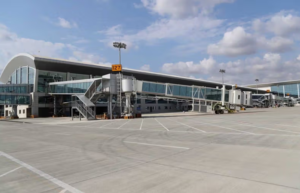
When it comes to air travel, having a seamless experience at the airport can make a difference in your trip. In Africa, some airports stand out for their exceptional facilities, services, and overall passenger experience.
Skytrax, an internationally recognized organization that assesses airlines worldwide, recently unveiled its report on the best airports globally.
According to the report, in the regional space, Durban’s King Shaka Airport in South Africa ranks as the top airport in Africa.
For the awards process, a regional airport is one that predominantly serves domestic or regional international flights. It may also serve a small number of intercontinental routes, but the primary focus is on the short-haul and regional markets.
Below are 10 best international airports in Africa in 2024:
1.Durban King Shaka Airport (South Africa).

King Shaka International Airport stands as a beacon of excellence among Africa’s best international airports. With a total floor area of 102,000 m2 (1,100,000 sq ft), the terminal is capable of handling 7.5 million passengers per year.
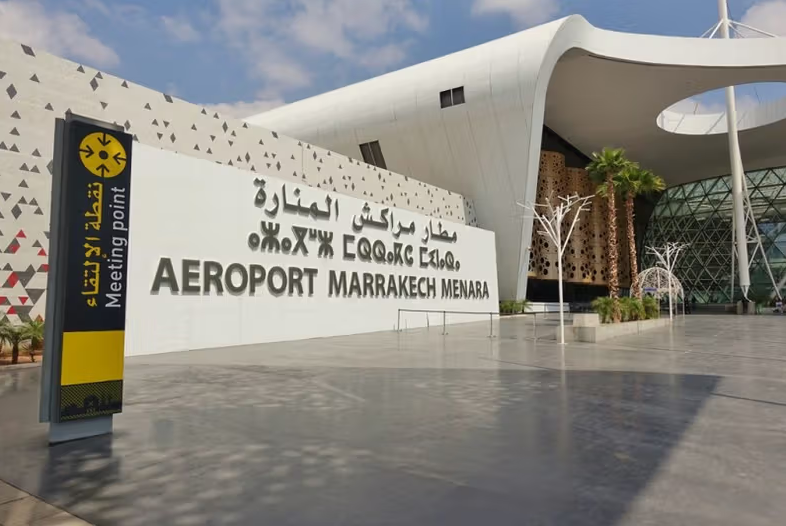
2.Marrakech Airport (Morocco)

Marrakech International Airport, located in Morocco, serves as a gateway to one of the country’s most vibrant and culturally rich cities. The air terminals (1 and 2) are 22,000 m2 (236,806 sq ft) and designed to handle 2,500,000 passengers per year.
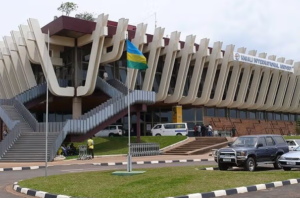
3.Kigali Airport (Rwanda)

Kigali International Airport, formerly known as Gregoire Kayibanda International Airport boasts modern facilities and infrastructure, including a single terminal equipped to handle various aircraft sizes.
It is also of regional importance as it serves Congolese, Burundian and Ugandan cities. Its terminal building handles a capacity of 1.5 million passengers per year.
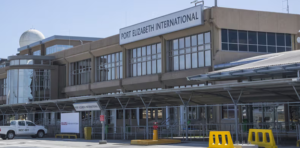
4.Port Elizabeth Airport (South Africa).

The Port Elizabeth airport was once called the H. F. Verwoerd Airport. It offers flights to and from Johannesburg, Bloemfontein, Durban, Cape Town and East London. The airport currently handles more than 1,2 million passengers per year, over 60 000 scheduled flights and over 800 tons of cargo.
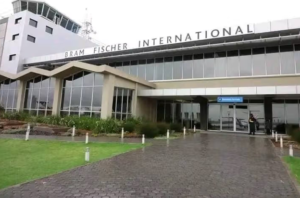
5.Bloemfontein Airport (South Africa)

Formerly known as Bloemfontein Airport, it was renamed Bram Fischer International Airport in 2012 by President Jacob Zuma. The airport offers a world-class airport operation that caters for more than 300 000 passengers and 17 000 air traffic movements per annum.
6.East London Airport (South Africa)

East London Airport (ELS) is a small, but busy airport serving the city of East London, in the Eastern Cape province of South Africa. The airport handles between 20 and 30 flights daily, which bring 946,000 people to East London each year.
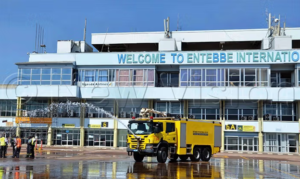
7.Entebbe Airport (Uganda)

The British Colonial authorities opened the airport due to its strategic location on Lake Victoria. Entebbe International Airport sits directly on the equator at latitude 00.020 North and longitude 320 East, earning it the nickname “Airport on the Equator.”
8.Antananarivo Airport (Madagascar).

Antananarivo Ivato International Airport has two main terminals: one terminal for domestic flights and one terminal for international flights. In December 2021, a new terminal opened. Antananarivo airport handled over 1 million passengers in 2019, first time in 20 years.
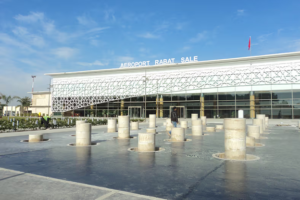
9.Rabat Airport (Morocco).

Rabat Airport, situated in Salé, Morocco, serves both as a civilian and military airport, catering to the needs of Rabat, the capital city, as well as the wider region.
10.Luanda Airport (Angola).

Luanda International Airport, (IATA Airport Code: LAD) is the current international airport serving Angola’s capital city Luanda and the rest of Angola.
Entebbe International Airport experienced a remarkable increase in both passenger and cargo traffic in April 2024. The airport handled a total of 164,705 international passengers, comprising 82,247 arrivals and 82,458 departures. This averages to approximately 5,313 passengers per day. This figure represents an increase of 38,515 passengers compared to April 2023, when the airport recorded 126,190 international passengers.
In addition to the surge in passenger traffic, Entebbe International Airport also saw significant activity in cargo operations. In April 2024, the airport recorded 1,768 metric tonnes of imports and 3,953 metric tonnes of exports, totaling 5,721 metric tonnes of cargo handled. This reflects Entebbe’s crucial role in facilitating international trade and the movement of goods, particularly fresh produce like fish, flowers, vegetables, and fruits, which are major exports to markets in the Netherlands, Belgium, and the Middle East.
PASSENGER RAIL FOR KAMPALA SET TO RESUME
This Thursday, limited passenger services resume between Kampala and Namanve, following suspension last year to pave the way for the rehabilitation and upgrade of the existing line.
The passenger services will feature departures from Namanve to Kampala at 6.40 and 7.45 am and evening departures from Kampala at 5.30 and 6.50 pm to with each trip taking about 40 minutes. A one-way ticket will cost 2,000 shillings.
With the announcement, Uganda Railways Corporation reiterated that it has not abandoned the city rail transport system, though it will take longer to realize, according to officials.
The light rail transport system would see passenger trains operate across the capital Kampala, which will greatly reduce the cost of transport, congestion and delays.
However, URC says the problem with Kampala is that when it was being planned, to there was no provision for that transport system.
“This will make it hard to for us, but it is in our plans, though for now we are focussing on restoring the existing but dilapidated infrastructure”, says John Linonn Sengendo, the head of communications at URC.
“We have a lot we are doing and we have a lot that we want to do, funds allowing,” Sengendo says, appreciating the funding by Uganda Development Bank towards most of the projects today.
“If, for example, government focused resources on railway like they have done for roads, there’s a lot we can do. Can you imagine if we only had like 1 trillion shillings for four years!”
According to Sengendo, there are currently five coaches or wagons, each with a capacity of 120 to 150 passengers, meaning that they can carry between 600 and 750 passengers per trip.
Another coach is expected in the country a month later. The Namanve-Kampala train will have five stopovers at Namboole, Kireka, Interfreight Nakawa and Makerere University Business School-Nakawa.
URC says it has made orders for more coaches which will increase their capacity.
“They take long to complete and deliver, because we are deploying new coaches. So it might take up to to three months.”
On public sentiments about the meter gauge railway being “outdated”, Sengendo says that on the contrary, even developed countries like Japan are still deploying MGRs.
He says the standard gauge railway is very expensive and will not do Ugandans good if all resources are put into it.
“If you see the resources that Tanzania has put in, we don’t have those resources. And by the way, even with the diesel-powered MGR, you cannot see much difference. Our MGR will be doing exactly what the Tanzania SGR is doing.”
In the short term, the plan is to extend the passenger services to Kyengera on Masaka Road,band to Port Bell on Lake Victoria and from Namanve to Mukono.
“Later we are going to extend the services to Bujuuko, and from Mukono to Lugazi, and works on that line could take three years. But that is because of the resources, it all depends on when the money will arrive,” Sengendo says.
He says they are also constructing state-of-the-art passenger shelters, with “park and ride” abilities, to enable motorists drive in, park and bord the train.
ROAD TRANSPORT RATES ARE HIGH IN EAST AFRICA
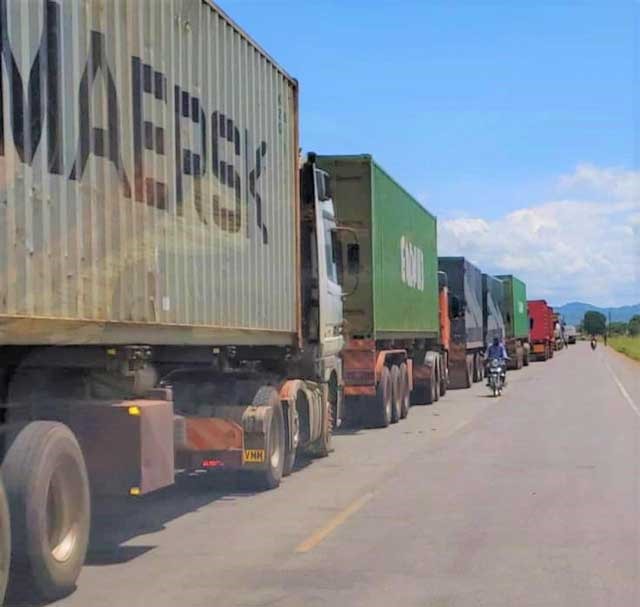
Road transport rates per container in East Africa remains higher than the global average impacting trade and investments in the region, according to Pauline Ukwalu from the Shippers Council of East Africa.
Ukwalu, who spoke during the East African Business Council (EABC) webinar on April.25, rates per container per kilometer from Mombasa to various cities such as Nairobi, Kampala, Kigali, Goma, and Juba range between USD 1.88 and USD 3, notably higher than the global benchmark of USD 1.
She also pointed out the inefficiencies at the Port of Mombasa, where the average ship turnaround time is 79 hours—far exceeding the global average of 24 hours. Transit times to Busia and Malaba also surpass the targets set by the Mombasa Port and Northern Corridor Charter.
However, Emmanuel Rutagengwa, from the Central Corridor Transit Transport Facilitation Agency (CCTTFA), reported significant improvements at Dar es Salaam Port, where enhancements have reduced ship turnaround and cargo dwell times substantially, and increased cargo throughput.
Dr. Merian Sebunya, Chairperson of the National Logistics Platform, Uganda, emphasized the detrimental impact of high transport costs and inadequate infrastructure on businesses. She advocated for more effective collaboration among public trade facilitation agencies to enhance corridor performance.
The webinar brought together over 100 stakeholders from various sectors across the EAC and beyond, highlighting the need to address challenges in regional transport logistics.
The construction of a fish landing harbor in Kilwa Masoko on the Indian Ocean coastline in the Lindi region, which has reached 42 percent completion, opens another frontier of competition between Tanzania and Kenya, which also expects to complete a similar facility at Shimon this year.
Tanzanian President Samia Suluhu Hassan laid the foundation stone for the construction of the fishing harbor in September last year. The construction of this facility is being undertaken by China Harbor Engineering Company Ltd. During the launch last year, Hassan also commissioned 160 modern fishing boats to be used by artisanal fishermen in deep seas. The boats will be lent to the fishermen without interest.
When completed, the fishing harbor will cost TSh. 266 billion (about 106 million U.S. dollars) and will have the capacity to store 90 tones of frozen fish daily. The facility will be managed by the Tanzania Ports Authority (TPA) and will also house fish processing plants and a workshop for repairing fishing ships and boats, as well as making fishnets. The facility is projected to employ more than 30,000 youth, according to government officials.
In an earlier interview, the Minister of Livestock and Fisheries Abdallah Ulega said that the provision of the 160 fishing boats to artisanal fishermen aims to boost the fisheries’ contribution to the country’s economic growth, targeting an increase from 1.8 percent to 10 percent by 2036. The fishing boats will be loaned to artisanal fishermen operating in fishing cooperatives in the Indian Ocean, Lake Victoria, Lake Tanganyika, and Lake Nyasa.
On the other hand, the Kenya Ports Authority (KPA) plans to finish the construction of a KSh2.6 billion Shimoni Fishing Port in Kwale County before the end of this year. President William Ruto officially launched the project in November 2023 and directed the KPA and the contractor, Southern Engineering Company Ltd (SECO), to complete the project in time.
The facility, which is located adjacent to the famous tourist site Kisite-Mpunguti Marine Park encompasses a modern jetty measuring 75 meters by 30 meters with a causeway measuring 135 meters long and meters wide.
The project is part of President Ruto’s plan to unlock the fisheries potential in the Indian Ocean to improve income and food security and create jobs for locals. Marine fisheries in Kenya constitute 26,000 tones of fish harvested annually, which is about 17 percent of the total national fish production.
The sector, according to Kenya Fisheries Services (KFS), has a potential of about 300,000 tonnes per year. The construction of the Shimoni port is expected to have a positive impact on trade and economic growth, with large-scale exploitation of the fish industry bolstered by a ready market and value addition, which will spur the creation of the Special Economic Zones. Kenya has in the recent past improved its profile in unlocking the ‘Blue Economy’.
The industrial fishing port infrastructure will include a multi-purpose berth that will incorporate fish and conventional cargo handling, cold storage facilities, reefer stations, and value addition, including fish processing plants. The existing jetty will also be rehabilitated to continue serving the local fishermen and support tourism.
The Western Indian Ocean has resources worth more than Sh2.2 trillion annual output, with Kenya’s share being about 20 percent of this. Optimal exploitation of marine fishing is hindered by infrastructural limitations and inappropriate fishing craft and gear. Artisanal fishers mainly restrict their operations to the continental shelf because they are ill-equipped in terms of craft and equipment to fish in the deep sea.
The deep-sea waters are left to Distant Water Fishing Nations (DWFN), which mainly fish tuna species. Kenya lies within the rich tuna belt of the West Indian Ocean, where 25 percent of the world’s tuna is caught. Foreign fishing fleets can operate in Kenya’s Exclusive Economic Zone (EEZ) through the regional and international agreements and cooperation provisions of the National Oceans and Fisheries Policy, which allow governments to continue granting fishing rights in their EEZs, taking into account the state of the stock and economic returns.
In December 2017, former President Uhuru Kenyatta suspended the licenses of foreign trawlers as part of efforts to grow the country’s blue economy through value addition. During the 54th commemoration of the country’s independence, he said that the ban on foreign vessels would help increase fish processed locally sevenfold. Kenya, the president announced, loses about 10 billion shillings ($97 million) a year to foreign boats fishing without permission.
Maritime stakeholders contend that the dedicated fish port project will expand the country’s plans to develop port infrastructure and complement the existing Mombasa and Lamu commercial seaports.
The fish port facility is also expected to have a shipyard with a dedicated basin for floating docks and vessel maintenance, fishing and port-related amenities, small craft services, and access roads for seamless service delivery.
James Rai, the Shimoni fish port project coordinator, said that the KPA and the contractor have increased the speed of work at the first fish-dedicated seaport in Kenya. According to Rai, other amenities in the pipeline include a power substation, water storage tanks, a perimeter fence, the main ablution block, a fish meal plant, a bio-digester, and waste-water management from the fish processing plant.
“But the entire new fishing harbor is likely to be completed by June next year and would be a game-changer for development,” he said, adding that the port project is designed to improve socio-economic conditions for the people of Shimoni and Wasini islands, who are traditionally fisher folk.
The article was published by the editorial team at the FEAFFA Secretariat. For any enquiries, contact us via Email: editorial@feaffa.com/ freightlogistics@feaffa.com / onionga@feaffa.com Tel: +254733780240